Consumer-Resource Model
In this section, we provide background information on the equations used in the mechanistic CRModel. There exist several variants of consumer-resource models in the literature, see the references below. The consumer–resource model we use is inspired by Niehaus et al. (2019) and builds on Monod kinetics, extending it to multi-species, multi-resource systems.
Assumptions
Biomass Growth: Bacterial growth follows Monod kinetics, limited by resource availability.
Resource Consumption: Resources are consumed proportional to growth (yield).
Metabolic Production: Bacteria secrete byproducts proportional to biomass.
Well-Mixed: The system is a chemostat or batch reactor with homogeneous concentrations.
Species Dynamics
Let \(X_i\) be the biomass of species \(i\) and \(S_j\) be the concentration of resource \(j\).
The specific growth rate \(\mu_{ij}\) of species \(i\) on resource \(j\) is
where \(r_{ij}\) is the maximum growth rate and \(K_{ij}\) is the half-saturation constant.
The total growth rate of species \(i\) is the sum over all resources. That is,
Including the death rate of species \(i\), \(k_i\), and dilution \(D\), yields
In the CRModel implementation, the dilution \(D\) can be either constant or time-dependent.
Resource Dynamics
Resource \(j\) is affected by three main processes:
Inflow and Outflow: Described by \(D(S_j^{\mathrm{in}} - S_j)\), representing the dilution of the resource due to inflow and outflow.
Resource Consumption: Proportional to microbial growth, where \(a_{ij}\) denotes the amount of \(S_j\) consumed per unit growth of \(X_i\) (inverse yield).
Byproduct Secretion: Proportional to biomass, where \(b_{ij}\) denotes the production rate of \(S_j\) by \(X_i\).
The resulting evolution equation of \(S_j\) is
Example
We construct a simple one-species, one-resource system and initialize the corresponding model parameters.
from mgrowthctrl.models import CRModel, CRModelParams
from mgrowthctrl.models.base import ModelNames

params = CRModelParams.from_shapes(n=1, m=1)
print(params.r.shape)
print(params.K_ij.shape)
print(params.k.shape)

names = ModelNames(["biomass"], ["substrate"])
model = CRModel(names=names, params=params)
Next, we specify a minimal set of parameter values for growth, uptake, and death rates.
model.r[0][0] = 1
model.a[0][0] = 1
model.k[0] = 0.1
We can use the model.get_params() function to verify that the model has loaded the specified parameters.
We then simulate the system over a given time horizon starting from initial conditions for biomass and substrate.
import numpy as np

t_sim = np.linspace(0, 120, 200)

sim = model.simulate([0.1, 10], t_sim)
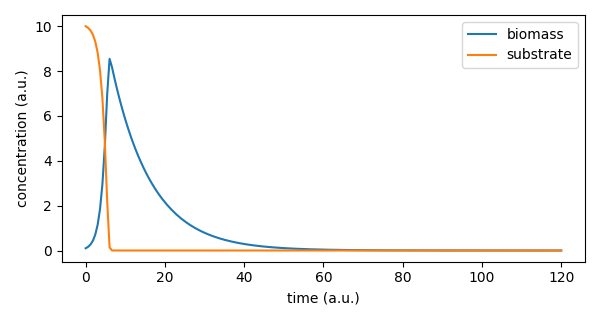
Finally, we visualize the resulting biomass and substrate trajectories.
import matplotlib.pyplot as plt

plt.figure(figsize=(6, 3.2))
plt.plot(sim.t, sim.X[0, :], label="biomass")
plt.plot(sim.t, sim.S[0, :], label="substrate")
plt.xlabel("time (a.u.)")
plt.ylabel("concentration (a.u.)")
plt.legend()
plt.tight_layout()
plt.savefig("crm_simple_example.png")
plt.show()
Here’s what the simulation result look like:
API Documentation
- mgrowthctrl.models.crm.model.DType
Either a constant value or a function of time
- Type:
The type of the D parameter
alias of
float|Callable[[float],float]
- mgrowthctrl.models.crm.model.ParamsDict
The type of the param dictionary, with most of its values as ndarrays and the dilution rate given as a float or time-dependent value.
alias of
Dict[str,ndarray|float|Callable[[float],float]]
- class mgrowthctrl.models.crm.model.CRModelParams(
- r: ndarray,
- a: ndarray,
- b: ndarray,
- K_ij: ndarray,
- k: ndarray,
- S_in: ndarray,
- D: float | Callable[[float], float],
Bases:
objectContainer for CRM parameters.
- Dimensions:
n = number of species (consumers)
m = number of resources (metabolites)
- r: ndarray
Max growth rates (n, m)
- a: ndarray
Resource uptake rates per unit growth (n, m)
- b: ndarray
Metabolic byproduct secretion rates (n, m)
- K_ij: ndarray
Half-saturation constants (n, m)
- k: ndarray
Maintenance/death rates per species (n,)
- S_in: ndarray
Inflow resource concentrations (m,)
- D: float | Callable[[float], float]
Dilution rate (outflow), either as a constant, or as a function of time
- static from_shapes(n: int, m: int, *, init: float = 0.0, D: float = 0.0) CRModelParams
Initialize parameters with simple constants.
- as_dict() Dict[str, ndarray | float | Callable[[float], float]]
Return params as a dict compatible with crm_fit_backend.
- class mgrowthctrl.models.crm.model.CRModel(
- names: ModelNames,
- params: CRModelParams,
- backend: str | ArrayBackend = 'numpy',
Bases:
BaseODEModelMonod-style Consumer–Resource model using the BaseODEModel.
- static from_dict(d: Dict[str, Any], backend: str = 'numpy') CRModel
Rebuild a CRModel from a dict produced by to_dict().
- classmethod from_single_species_data(
- df,
- time_col: str,
- x_col: str,
- s_cols: List[str],
- *,
- K_prefactor: float = 2.0,
- fit_a: bool = True,
- n_spline_points: int = 400,
- r_mask=None,
- b_mask=None,
- a_mask=None,
- backend: str | ArrayBackend = 'numpy',
Build a single-species CRM with mechanistic initial parameters derived from data. This also attaches the data (_df, _time_col, _x_cols, _s_cols) to the model instance so subsequent .fit() calls don’t need arguments.
- set_params(params: CRModelParams) CRModel
Set internal parameter arrays from a CRModelParams instance.
- get_params() CRModelParams
Return a copy of the current parameters.
- compute_rhs(t, X, S)
Compute dX/dt, dS/dt given X, S using current parameters.
- fit(
- df: DataFrame,
- time_col: str | None = None,
- x_cols: List[str] | None = None,
- s_cols: List[str] | None = None,
- method: Literal['least_squares', 'mcmc'] = 'least_squares',
- *,
- params0: Dict[str, ndarray | float | Callable[[float], float]] | None = None,
- lb_factor: float = 0.0,
- ub_factor: float = 10.0,
- X0: ndarray | None = None,
- S0: ndarray | None = None,
- include_metabolites: bool = True,
- weight: Literal['median', 'equal'] = 'median',
- n_time: int = 300,
- fit_a: bool = True,
- nsimu: int = 10000,
- sigma2: float = 12.0,
- burn: float = 0.8,
- nsamp: int = 200,
- seed: int = 1234,
High-level fit method. The given parameters are passed along to other functions based on the given
method. See the documentation of the relevantfit_methods for details.Fits the model in place and returns self. Description of the parameters shared by all the “fit” functions:
- Parameters:
df – The DataFrame to fit data to
time_col – The name of the time column in
dfx_cols – The names of the consumer (X) columns in
dfs_cols – The names of the substrate (S) columns in
dfmethod – The fitting method to use
params0 – A dictionary of initial paramater values that will be used to instantiate a
CRModelParamsinstance if no params have been given at construction time.
- fit_least_squares(
- df=None,
- time_col: str | None = None,
- x_cols: List[str] | None = None,
- s_cols: List[str] | None = None,
- *,
- params0: Dict[str, ndarray | float | Callable[[float], float]] | None = None,
- lb_factor: float = 0.0,
- ub_factor: float = 10.0,
- X0: ndarray | None = None,
- S0: ndarray | None = None,
- include_metabolites: bool = True,
- weight: Literal['median', 'equal'] = 'median',
- n_time: int = 300,
- fit_a: bool = True,
Mechanistic least-squares fit. All arguments (df, time_col, x_cols, s_cols) default to attached/internal values if None.
A description of the least-squares-specific parameters:
- Parameters:
lb_factor – Lower bound factor, multiplied with starting parameters to determine the lower bound of the estimation.
ub_factor – Upper bound factor, multiplied with starting parameters to determine the upper bound of the estimation.
X0 – Initial X values, will be estimated from the data if not given
S0 – Initial S values, will be estimated from the data if not given
include_metabolites – Whether to calculate time-series residuals for metabolites (S) or only for species (X).
weight – Per-species/per-metabolite weighting. If “median”, scales weights based on the median value of the data. If “equal”, does not scale weights.
- fit_mcmc(
- df=None,
- time_col: str | None = None,
- x_cols: List[str] | None = None,
- s_cols: List[str] | None = None,
- params0: Dict[str, ndarray | float | Callable[[float], float]] | None = None,
- fit_a: bool = True,
- nsimu: int = 10000,
- sigma2: float = 12.0,
- burn: float = 0.8,
- nsamp: int = 200,
- seed: int = 1234,
Run MCMC parameter estimation. All arguments (df, time_col, x_cols, s_cols) default to attached/internal values if None.
A description of the MCMC-specific parameters:
- Parameters:
nsimu – Number of simulations in each chain
sigma2 – Initial observation error
burn – Fraction of samples to drop as burn-in
nsamp – Number of posterior samples to pick
seed – Random seed
- simulate(
- y0: ndarray | torch.Tensor | list | tuple | float | int,
- t: ndarray | torch.Tensor | list | tuple | float | int,
- *,
- log_space: bool = False,
- method: str | None = None,
- solver_options: Dict | None = None,
A convenience wrapper for
BaseODEModel.predict
- to_dict() Dict[str, float | list]
Serialize model to a dict.
References
Levins, R. (1968). Evolution in changing environments: some theoretical explorations (No. 2). Princeton University Press.
MacArthur, R. (1970). Species packing and competitive equilibrium for many species. Theoretical Population Biology, 1(1), 1-11.
Niehaus, L., Boland, I., Liu, M., Chen, K., Fu, D., Henckel, C., … & Momeni, B. (2019). Microbial coexistence through chemical-mediated interactions. Nature Communications, 10(1), 2052.
Butler, S., & O’Dwyer, J. P. (2018). Stability criteria for complex microbial communities. Nature Communications, 9(1), 2970.